 For many years now, I have been growing my own strawberries. The first year that I attempted to grow strawberries, I was so overwhelmed and very disappointed. I didn’t know which varieties to buy, how to grow them, why my strawberries weren’t producing a lot of strawberries, and what a “runner” was and how it dramatically could effect my harvest! Today we are going to learn about strawberries and how to get the best yield out of your strawberry plants.
So lets talk about the different varieties of strawberries and strawberry types. There are hundreds of different varieties but there are only three strawberry types. The three types of strawberries are June-bearing strawberry varieties, ever-bearing strawberry varieties and day neutral strawberry varieties. Here are descriptions of the 3 strawberry types provided by StrawberryPlants.org.
Strawberry Types & Varieties
June-bearing strawberry varieties:
Any list of strawberry varieties will probably contain more June-bearing strawberry varieties than any other. June bearers are tremendously popular and common. They typically produce the largest strawberries, and do so over a period of two to three weeks, on average. Most June bearing strawberry varieties produce a harvest around the month of June, hence the name. However, strawberry varieties are further classified into Early Season, Midseason, and Late Season. By selecting strawberry plant varieties that produce during different parts of the season, you can prolong your harvest and enjoy fresh strawberries for an extended period of time. June bearing strawberries are most often of the Garden Strawberry variety (Fragaria x ananassa). June bearing strawberry varieties are often planted using the matted row system.
Everbearing strawberry varieties:
Everbearing strawberry varieties aren’t really “everbearing.” They generally produce two harvests per year: one in the spring and another in the late summer or fall. Under ideal conditions, it is possible for some everbearing strawberry varieties to produce three berry harvests. Most everbearing strawberry types are of the species Fragaria vesca. In general, everbearing strawberry varieties put out less runners (or no runners at all) than the June bearing varieties, as most of the plants productive energy is directed toward producing multiple strawberry harvests. Everbearing strawberry varieties are often planted using the hill system or in locations where space is limited.
Day-neutral strawberry varieties:
Day neutral strawberry varieties are unique. Unlike June bearing varieties, day neutral strawberries will produce a good yield in the first year they are planted. They flower and set strawberries whenever the temperature is between 35 and 85 degrees. They will still be producing fruit in October during milder years. The drawback to day neutral strawberry plants is that they produce smaller strawberries than do the June bearing and everbearing strawberry varieties. Their fruit is usually small to medium in size, rarely exceeding one inch. Day neutral strawberry varieties are often planted using the hill system or in locations where space is limited.
Here is a great chart that will help you find the right strawberry type and variety for your region as well as the desired flavor you are looking for. Keep in mind, oftentimes strawberries are much sweeter the smaller they are. If they are larger, they often times have a lot of water in them making them not as sweet.
Strawberry type and varieties chart
Follow This One Tip In Your Garden & Get A Ton Of Organic Strawberries!

So now that you are a bit more educated about the different types and varieties of strawberries, lets talk about how to get the most out of your strawberry plants! In my garden, I have the ever-bearing strawberries and June-bearing strawberries. We eat strawberries all season long on these plants and they produce enough strawberries for our family that I have no need to even buy them at the farmers markets.
My everbearing strawberry plants are pretty much maintenance free, just plant and pick. My June-bearing take a little more work, but it is well worth it. June-bearing is one of the most planted strawberry types in todays gardens. My first year, I got very few strawberries. What was I doing wrong? I wasn’t pinching off my runners! “Runners”?? Let me explain.
When you purchase your strawberry plant, you have a central plant. As it grows it produces runners. Runners are long stems that run off the central plant and create baby strawberry plants. These baby strawberry plants suck the nutrients out of the central plant and the central plant will lose its ability to produce fruit.

This might sound great, you automatically get more strawberry plants for free, but it is not a good thing! Again, these “runners” strip the central plant of its nutrients and the central plant will produce only a very little amount of strawberries.
So if you want to have a ton of strawberries, You must remove the runners!
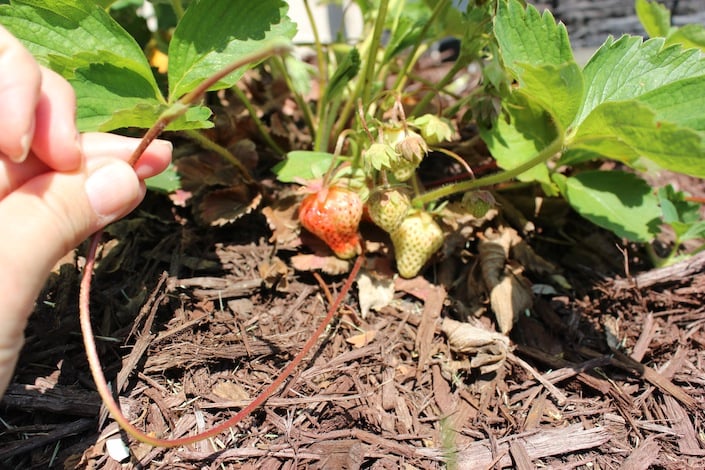
To remove the runners, follow the runner to the central plants base.

Notice that the my runners have red stems. Not all red stems are runners though so make sure it is a runner before removing. Also depending on the variety, the stem might not be red. A runner is always longer (or running) from the central plant. Now simply remove the runner at the base of the plant.

By removing the runner you are allowing the central plant to get all the nutrients it needs to produce a lot of wonderful and delicious strawberries! This simple step of removing runners will allow your garden to flourish with strawberries. Strawberries are one of the easiest fruits to grow. So why not give it a try? Once you have home grown strawberries out of your garden, it is hard to go back to store bought. They really are that good! Happy gardening everyone!
Interested In Getting More Organic Tomatoes Out Of Your Garden?
If you like this post, then be sure to check out this post:
Follow This One Tip And Get A Ton Of Organic Tomatoes
You may not be getting all the tomatoes that you could be from your tomato plants. I implemented this tip in my garden this year and had to give away my tomatoes, I had so many! 🙂

Photo Credit: » Zitona « via Compfight cc


The U. of MO has found that strawberry beds covered with Remay in the winter produce up to 40% more berries…we found this true and last year was first time we had lots to put in freezer. Straw doesn’t protect as well.
@mutti66 Great tip! I will try that this winter, thanks so much!
Hi, do i cut the runner at the central of the plant before allowing to root into a new pot of soil ? or would i allow to root first before detaching from plant?
Also when the strawberries come to an end do i remove anything from the plant? i never have done then i get the brown crusty leaves the following year and i remove them but i’m never too sure what i should be doing?
Thank Suzanne
@mutti66 What is Remay ???
@LynnCrone @mutti66 It is a lightweight cloth that helps protect the plants from frost and damage that might happen over the winter months.
@LynnCrone You can buy it at most garden centers. Home Depot,Lowes or thru most any seed catalog. I get mine from http://www.johnnyseeds.com
I’ve grown strawberries for years. W use grass clippings(dried) around plants and try to keep them in the row. They require sunshine or will not produce. Its best to get a new patch going every three years or till down the center with a garden tiller, then the next year you will get new plants in the center and can take out the edge rows the next year. Hope this helps.
I have WILD strawberries on my property, what can I do to increase production, they are very tiny and few berries
There is no way to increase wild strawberry size, and yield is limited to the sheer number of plants you can grow. Fertilize as normal for domestic strawberries if you want. The thing about wild strawberries is that the flavor is incomparable to anything domestic; you can simply pick and add your wild strawberries whole to a flat of other berries to give a HUGE wallop of true strawberry flavor to all of it. Or, count your blessings and use just the wild strawberries for freezer jam — I promise, you will never want anything else.
I disagree that there is no way to increase wild strawberry size. Many years ago, we found some really delicious wild strawberries, that were relatively decent size for wild ones. We dug about 20 of the best plants up and then transplanted them, having prepared a bed as if for cultivated regular strawberry production. It was well fertilized with rotted horse manure and compost and the bed was treated as if for cultivated varieties.. The leaves and fruit ended up about double the size of the wild ones (still relative small compared to cultivated strawberries, but much larger than then had been, and they still tasted wonderful.
I have a strawberry pot, can you tell me what kind of berrys I should plant in it ,& how to go aabout planting, seeds or plants?
Plants are best, especially if you are just starting out. You can choose any berry varieties that you would like. I’d speak to someone at the gardening center to see what variety grows well in your area! Good luck!
what is remay?
What’s Remay?
do you know if you really have to pluck the flowers on the first planting to increase yield for the next year?Do we have to wait?
@Oemissions The first year I did not pluck the flower and I got plenty of berries. Now year 2 & 3 (same plant) I had a ton of berries! I know this, that the first year you will have much less plucking or not.
This article has a lot of good info if you have never planted strawberries or have been unsuccessful with plants bearing fruit.
Can you plant the runners and make more plants?
@Sarah MchughRumsey Yes Sarah you most certainly can. Just make sure that the plant has rooted into the ground and then dig deep enough not to disturb the root and transplant into a pot. You could also take a runner that hasn’t rooted yet at the very tip of the runner (look at the top picture of the runners). You can see in that photo that there is a plant and it hasn’t rooted yet. Just take a small pot with some soil in it and place the bottom end of the tip of the runner/plant lightly into the soil. Leave the runner attached to the main plant until the root system in the pot has developed. It should root into the pot in a few weeks. Once it does, then cut the runner off from main plant and you will have your own strawberry plant for next year.
@hallecottis Thanks! I went to put my runner in a pot and found out that I accidentally planted so it looped under the main plant. Oh well. I’ll keep an eye out for more runners though.
I read the article, and while the tip is most likely correct, most varieties of strawberry plants only live 3 years, then die. The runners perpetuate the species, so if you disconnect them from the momma plant, make sure you replant them! otherwise you will be buying and replacing plants continuously.
We have grown strawberries for years on a circulatory format. We train the runners from the patch in a single direction, and every year we till (or remove) the original plants on the opposite side, away from where the runners were planted. Eventually the entire strawberry row moves the width of the garden, where we then train runners again in the opposite direction to move back across the way they had come from. This makes use of the limited lifespan of the plants themselves by providing free additional plants. We also have dug the annual runner sets at the end of the growing season, along with the original roots, and overwintered them in a 5-gallon bucket of moist sand and stored them in the unheated garage (zone 3-4). Come spring, simply dump out the bucket, pick out the roots, and plant as normal. Viola! A whole new strawberry bed for free. Usually that was only necessary if the weeds took over and a clean slate was preferred. They’re really remarkable plants.
I have a row of strawberries between my garage and the sidewalk & have never picked off any of the runners in the 3 years we’ve had them. The entire bed filled itself in and we get A LOT of berries. I’m not sure what types we planted, 2 varieties with at least one of them producing runners. Now that they’re starting to creep up on the sidewalk, I’d like to pinch them off. Should I leave the happy ones where they are? The nodules have rooted on some of them, so I’m thinking I should leave those alone.Thanks, Heather
@retrogirl02 If you want more strawberry plants for next year, then you can leave the ones that have already rooted themselves. You will not hurt the central plant if you remove the ones creeping on your sidewalk, so I would remove those. Sounds like you had some successful varieties that you planted. Good for you 🙂
@hallecottis @retrogirl02 thank you for taking the time to respond. Happy gardening! =)
Bless you for sharing this info. I am planning on doing a strawberry bed in the near future. I haven’t made it to fruit gardening yet, but if you wanna see some pics of my backyard garden (in Florida we are a little limited) I have pics of them here: http://busymomsdoitbest.blogspot.com/2012/05/just-cant-get-enough.html Thanks again!
Hi there, I just about 2 months ago planted some strawberries (species ?)in boxes on my screened patio. At first I got a few strawberries, I pinched them off and the runners look to have died. I water them with a spray bottle in the morning. Some leaves turned yellow and died. What can I do to save them?
@MirandaElgersma I was always told never spray the plant directly. If you can water them underneath or at dirt level it will help with the leaves changing. That is also the same with Tomato Plants
Interesting. What about when it rains? I am NOT buying rain jackets for my plants! 🙂
In the first year, do you remove the flowers (thereby removing all potential strawberries), in order to have a more abundant yield the following year? If you do this, which year is counted as year one of the three year cycle?
Great information! We grow several different types of strawberries and clip the runners too.
Hi, My plants are June bearing and have tons of runners – is it too late for this year? Is there an ideal time to remove them or just try to do it constantly? Thanks!
@Shalonne It isn’t to late to remove them and I just remove them as they appear. You should be fine 🙂
Thank you for this awesome tip!!! We live in strawberry country and I’m looking forward to planting next month. I am definitely going to remove those runners!!! So great.
Thanks for sharing with us again this week on AFW!
Have a beautiful weekend.
Be Well,
–Amber
Thank you for your submission on <a href=”http://www.nourishingtreasures.com”>Nourishing Treasures'</a> Make Your Own! Monday link-up. Check back later tonight when the new link-up is running to see if you were one of the top 3 featured posts! 🙂