 For many years now, I have been growing my own strawberries. The first year that I attempted to grow strawberries, I was so overwhelmed and very disappointed. I didn’t know which varieties to buy, how to grow them, why my strawberries weren’t producing a lot of strawberries, and what a “runner” was and how it dramatically could effect my harvest! Today we are going to learn about strawberries and how to get the best yield out of your strawberry plants.
So lets talk about the different varieties of strawberries and strawberry types. There are hundreds of different varieties but there are only three strawberry types. The three types of strawberries are June-bearing strawberry varieties, ever-bearing strawberry varieties and day neutral strawberry varieties. Here are descriptions of the 3 strawberry types provided by StrawberryPlants.org.
Strawberry Types & Varieties
June-bearing strawberry varieties:
Any list of strawberry varieties will probably contain more June-bearing strawberry varieties than any other. June bearers are tremendously popular and common. They typically produce the largest strawberries, and do so over a period of two to three weeks, on average. Most June bearing strawberry varieties produce a harvest around the month of June, hence the name. However, strawberry varieties are further classified into Early Season, Midseason, and Late Season. By selecting strawberry plant varieties that produce during different parts of the season, you can prolong your harvest and enjoy fresh strawberries for an extended period of time. June bearing strawberries are most often of the Garden Strawberry variety (Fragaria x ananassa). June bearing strawberry varieties are often planted using the matted row system.
Everbearing strawberry varieties:
Everbearing strawberry varieties aren’t really “everbearing.” They generally produce two harvests per year: one in the spring and another in the late summer or fall. Under ideal conditions, it is possible for some everbearing strawberry varieties to produce three berry harvests. Most everbearing strawberry types are of the species Fragaria vesca. In general, everbearing strawberry varieties put out less runners (or no runners at all) than the June bearing varieties, as most of the plants productive energy is directed toward producing multiple strawberry harvests. Everbearing strawberry varieties are often planted using the hill system or in locations where space is limited.
Day-neutral strawberry varieties:
Day neutral strawberry varieties are unique. Unlike June bearing varieties, day neutral strawberries will produce a good yield in the first year they are planted. They flower and set strawberries whenever the temperature is between 35 and 85 degrees. They will still be producing fruit in October during milder years. The drawback to day neutral strawberry plants is that they produce smaller strawberries than do the June bearing and everbearing strawberry varieties. Their fruit is usually small to medium in size, rarely exceeding one inch. Day neutral strawberry varieties are often planted using the hill system or in locations where space is limited.
Here is a great chart that will help you find the right strawberry type and variety for your region as well as the desired flavor you are looking for. Keep in mind, oftentimes strawberries are much sweeter the smaller they are. If they are larger, they often times have a lot of water in them making them not as sweet.
Strawberry type and varieties chart
Follow This One Tip In Your Garden & Get A Ton Of Organic Strawberries!

So now that you are a bit more educated about the different types and varieties of strawberries, lets talk about how to get the most out of your strawberry plants! In my garden, I have the ever-bearing strawberries and June-bearing strawberries. We eat strawberries all season long on these plants and they produce enough strawberries for our family that I have no need to even buy them at the farmers markets.
My everbearing strawberry plants are pretty much maintenance free, just plant and pick. My June-bearing take a little more work, but it is well worth it. June-bearing is one of the most planted strawberry types in todays gardens. My first year, I got very few strawberries. What was I doing wrong? I wasn’t pinching off my runners! “Runners”?? Let me explain.
When you purchase your strawberry plant, you have a central plant. As it grows it produces runners. Runners are long stems that run off the central plant and create baby strawberry plants. These baby strawberry plants suck the nutrients out of the central plant and the central plant will lose its ability to produce fruit.

This might sound great, you automatically get more strawberry plants for free, but it is not a good thing! Again, these “runners” strip the central plant of its nutrients and the central plant will produce only a very little amount of strawberries.
So if you want to have a ton of strawberries, You must remove the runners!
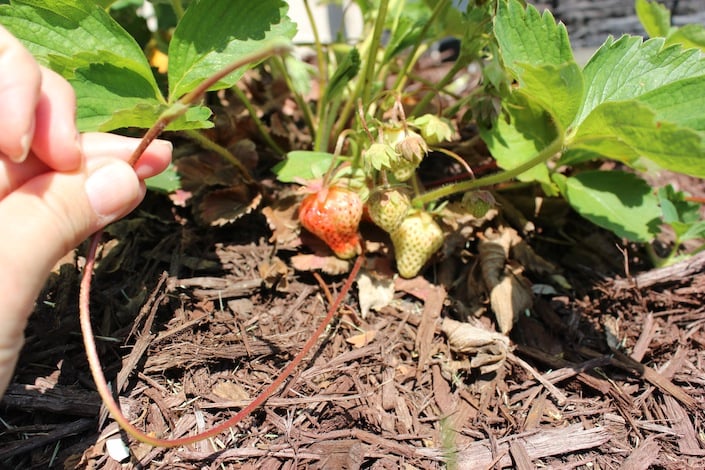
To remove the runners, follow the runner to the central plants base.

Notice that the my runners have red stems. Not all red stems are runners though so make sure it is a runner before removing. Also depending on the variety, the stem might not be red. A runner is always longer (or running) from the central plant. Now simply remove the runner at the base of the plant.

By removing the runner you are allowing the central plant to get all the nutrients it needs to produce a lot of wonderful and delicious strawberries! This simple step of removing runners will allow your garden to flourish with strawberries. Strawberries are one of the easiest fruits to grow. So why not give it a try? Once you have home grown strawberries out of your garden, it is hard to go back to store bought. They really are that good! Happy gardening everyone!
Interested In Getting More Organic Tomatoes Out Of Your Garden?
If you like this post, then be sure to check out this post:
Follow This One Tip And Get A Ton Of Organic Tomatoes
You may not be getting all the tomatoes that you could be from your tomato plants. I implemented this tip in my garden this year and had to give away my tomatoes, I had so many! 🙂

Photo Credit: » Zitona « via Compfight cc


I did not know this! Thank you for sharing this wonderful tip, and an excellent post about growing your own strawberries. I really enjoyed reading it and I learned a lot!
Great tip! I REALLY wanted to grow strawberries this year, but I had too much stuff going on during the time to plant. I settled for going to a local farm and picking 20 lbs, lol! Thanks for sharing with Healthy 2Day Wednesday; come back tomorrow to see if you were featured!
Hi There,
I featured your awesome post this week on Allergy-Free Wednesdays. Your post and other highlights can be seen here: http://www.thetastyalternative.com/2012/05/allergy-free-wednesdays-week-19-may-30.html
Please join us again this week for more allergy-free fun and inspiration.
Be Well,
–Amber
@thetastyalternative Thanks so much for the double feature Amber 🙂 I really do enjoy your site quite a bit 🙂 ~ Halle
Awesome information, thank you so much for sharing. I can’t wait to grow my own. I would love for you to check out my garden progress here: http://busymomsdoitbest.blogspot.com/2012/05/quick-garden-update.html Thanks again.
After we talked about this like a month ago and I picked the runners, which I only had a few, my plant took off!!! Not only did my plant grow even larger (I think I may remove my oregano and parsley out of that bed and just leave the strawberries and chives) but it also grew taller! And they are almost ready to harvest! I am thinking about adding more strawberries because I am guessing mine are June bearing.
Thank you Halle!!!
There is no way to increase wild strawberry size, and yield is limited to the sheer number of plants you can grow. Fertilize as normal for domestic strawberries if you want. The thing about wild strawberries is that the flavor is incomparable to anything domestic; you can simply pick and add your wild strawberries whole to a flat of other berries to give a HUGE wallop of true strawberry flavor to all of it.
I’ve grown strawberries for years, quite successfully, and never pinched off any runners. I am wondering if I should start doing so – as in, is it too late? Would it matter much? We already get plenty of berries for our family and the birds and bunnies. I thought letting the runners ‘go’ was how my strawberry patch was getting so large and plentiful, but I admit to knowing nothing about growing them other than plant, water, pick. ??
@AmbreEnglishFreer You might have a variety that doesn’t produce a lot of runners. You are right, they will replenish your old plants and help produce new ones for the next season. If you are producing a lot of strawberries already then you could leave them be until next season. You could always experiment on one plant and see if you notice a difference in your yield. It is different with all varieties. Hope this helps a bit 🙂
I recently took a gardening class from a sweet couple who owned a nursery for 40 years. They said to only let each strawberry plant to have 1 or 2 runners, so those runners can form new plants. Then they pick the original plants after three years (their production slows down after that) so that there are always new plants (from runners) that are producing well.
@btlfamily Good tip, I am on year 3 of some of my plants and I will also dispose of the plants after this year. Thanks for mentioning this.
How much room does a strawberry plant need? Could I grow it in a small rectangular box…almost like a window planter?
@smileatclaire absolutely! Some of my best strawberries came from boxes that hung over my deck rail. They only need about a square foot 🙂
Can you replant the runners to make more Strawberry plants? Do you need to germinate them first?
@AshleyRice No you can replant them right away and they will do just fine.
I want to know about fertilizing strawberries. I grow my strawberries in straw bales and have heard and seen pro’s and cons on fertilizing. When and How much do I fertilize with out getting huge leaves and few berries.
What kind of fertilizer do I need and how much for strawberrys in their 2nd year?
I just began my first garden this year. I planted a lot of vegetables in raised beds, some squash and tomatoes in pots and I filled a strawberry pot with strawberry plants. You can see my garden and the strawberry pot here http://www.creatingtreasures.blogspot.com/2012/06/garden-update-i.html
As you can see the leaves were green and luscious (2nd photo from the top) but I never got many or big strawberries whatsoever. Someone said that there wasn’t enough room for the roots. What do you think?
We have had 100 degrees F temperatures this past 10 days and although I moved the pot to under the shade my plants are wilting and drying up. Do they get revived when the weather gets cooler or are they just dying? i read somewhere that the plants hibernate and then come back.
The strawberry was the only plant I had no success with. 🙁 It seems to be cheaper to buy them at the store then to try to grow them. Looking for some knowledge and encouragement. thanks. 🙂
@mytreasuredcreations I would suggest you try a different kind of container. I tried growing my strawberries in a strawberry pot the first time. No success. The soil seemed to get too hot and dried out. I now just throw some plants in a container like a left over tree container from the nursery. I also put some in a raised garden. They are all doing well. I winter the container ones and they come back in the Spring. I would suggest you try a different kind of container.
Ok so now I know what I did wrong. I started with 6 plants, now there are about 50. How do I thin what I have and remove the runners?
@wennah I would pull every couple plants so you have room between the plants. Then cut any runners off close to the plant. Do not worry about thinning too much. If you have extra space left over, just allow a couple of runners that way and they will replant on their own.