 For many years now, I have been growing my own strawberries. The first year that I attempted to grow strawberries, I was so overwhelmed and very disappointed. I didn’t know which varieties to buy, how to grow them, why my strawberries weren’t producing a lot of strawberries, and what a “runner” was and how it dramatically could effect my harvest! Today we are going to learn about strawberries and how to get the best yield out of your strawberry plants.
So lets talk about the different varieties of strawberries and strawberry types. There are hundreds of different varieties but there are only three strawberry types. The three types of strawberries are June-bearing strawberry varieties, ever-bearing strawberry varieties and day neutral strawberry varieties. Here are descriptions of the 3 strawberry types provided by StrawberryPlants.org.
Strawberry Types & Varieties
June-bearing strawberry varieties:
Any list of strawberry varieties will probably contain more June-bearing strawberry varieties than any other. June bearers are tremendously popular and common. They typically produce the largest strawberries, and do so over a period of two to three weeks, on average. Most June bearing strawberry varieties produce a harvest around the month of June, hence the name. However, strawberry varieties are further classified into Early Season, Midseason, and Late Season. By selecting strawberry plant varieties that produce during different parts of the season, you can prolong your harvest and enjoy fresh strawberries for an extended period of time. June bearing strawberries are most often of the Garden Strawberry variety (Fragaria x ananassa). June bearing strawberry varieties are often planted using the matted row system.
Everbearing strawberry varieties:
Everbearing strawberry varieties aren’t really “everbearing.” They generally produce two harvests per year: one in the spring and another in the late summer or fall. Under ideal conditions, it is possible for some everbearing strawberry varieties to produce three berry harvests. Most everbearing strawberry types are of the species Fragaria vesca. In general, everbearing strawberry varieties put out less runners (or no runners at all) than the June bearing varieties, as most of the plants productive energy is directed toward producing multiple strawberry harvests. Everbearing strawberry varieties are often planted using the hill system or in locations where space is limited.
Day-neutral strawberry varieties:
Day neutral strawberry varieties are unique. Unlike June bearing varieties, day neutral strawberries will produce a good yield in the first year they are planted. They flower and set strawberries whenever the temperature is between 35 and 85 degrees. They will still be producing fruit in October during milder years. The drawback to day neutral strawberry plants is that they produce smaller strawberries than do the June bearing and everbearing strawberry varieties. Their fruit is usually small to medium in size, rarely exceeding one inch. Day neutral strawberry varieties are often planted using the hill system or in locations where space is limited.
Here is a great chart that will help you find the right strawberry type and variety for your region as well as the desired flavor you are looking for. Keep in mind, oftentimes strawberries are much sweeter the smaller they are. If they are larger, they often times have a lot of water in them making them not as sweet.
Strawberry type and varieties chart
Follow This One Tip In Your Garden & Get A Ton Of Organic Strawberries!

So now that you are a bit more educated about the different types and varieties of strawberries, lets talk about how to get the most out of your strawberry plants! In my garden, I have the ever-bearing strawberries and June-bearing strawberries. We eat strawberries all season long on these plants and they produce enough strawberries for our family that I have no need to even buy them at the farmers markets.
My everbearing strawberry plants are pretty much maintenance free, just plant and pick. My June-bearing take a little more work, but it is well worth it. June-bearing is one of the most planted strawberry types in todays gardens. My first year, I got very few strawberries. What was I doing wrong? I wasn’t pinching off my runners! “Runners”?? Let me explain.
When you purchase your strawberry plant, you have a central plant. As it grows it produces runners. Runners are long stems that run off the central plant and create baby strawberry plants. These baby strawberry plants suck the nutrients out of the central plant and the central plant will lose its ability to produce fruit.

This might sound great, you automatically get more strawberry plants for free, but it is not a good thing! Again, these “runners” strip the central plant of its nutrients and the central plant will produce only a very little amount of strawberries.
So if you want to have a ton of strawberries, You must remove the runners!
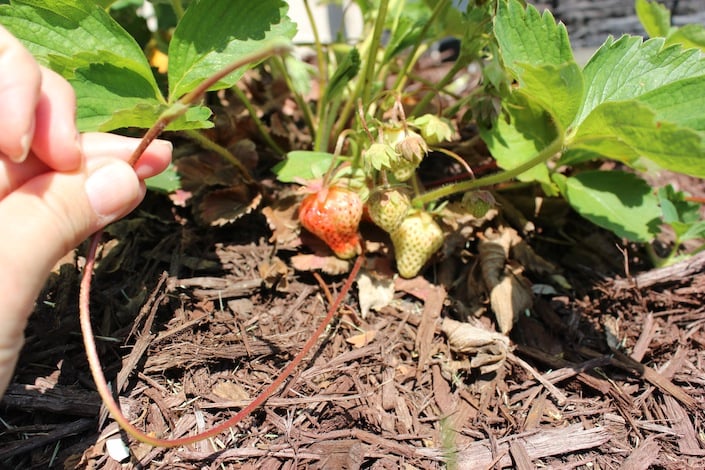
To remove the runners, follow the runner to the central plants base.

Notice that the my runners have red stems. Not all red stems are runners though so make sure it is a runner before removing. Also depending on the variety, the stem might not be red. A runner is always longer (or running) from the central plant. Now simply remove the runner at the base of the plant.

By removing the runner you are allowing the central plant to get all the nutrients it needs to produce a lot of wonderful and delicious strawberries! This simple step of removing runners will allow your garden to flourish with strawberries. Strawberries are one of the easiest fruits to grow. So why not give it a try? Once you have home grown strawberries out of your garden, it is hard to go back to store bought. They really are that good! Happy gardening everyone!
Interested In Getting More Organic Tomatoes Out Of Your Garden?
If you like this post, then be sure to check out this post:
Follow This One Tip And Get A Ton Of Organic Tomatoes
You may not be getting all the tomatoes that you could be from your tomato plants. I implemented this tip in my garden this year and had to give away my tomatoes, I had so many! 🙂

Photo Credit: » Zitona « via Compfight cc


We just tried strawberries in a raised bed and from 2 plants we have gotten NO berries for us to eat. However the birds, and possibly other wildlife (chipmunks, squirrels, raccoons???) always get the berries just before we do! I read about placing stones painted to look like strawberries around them. Also I’ve heard of a netting but not sure exactly what to get. I’m not giving up! Thanks for the great article.
@bonmom5 Oh no 🙁 I wish I could share a picture here (but can’t unfortunately). I built a cage that fits over my bed. It is made of chicken wire and is about 4 feet high and also has a top. This keeps animals, birds and other creatures out. Might work for you too.
@hallecottis Thank you. I hope to try that. new berries are now forming (so we must have the variety that produces twice a year)…I hope to get some berries this time! thanks again.
appreciate the tips. trying to grow blueberry’s now.
http://www.kbmulch.com
when i lived at home i tried growing strawberries. now i know why i never got very many.
Any advice on aphids and fruit fly getting into the strawberry patch? I will try the runner tip and see what happens!
@bonmom5 Rubber snakes, bought at the dollar store. Has worked for years now
This is really a great post! Thanks Halle for this great information!
Any advice on bugs – I seem to have everything except me enjoying my strawberries- little slugs, beetles, aphids – reluctant to use normal sprays – is there an organic way to get rid of them?
@ElkeDay Lady bugs work wonders, so do praying mantis. You can buy them at your local garden store. Also, used coffee grounds are good for the soil and good and keeping away pests. You can get coffee grounds at your local starbucks.
@ElkeDay
For aphids plant dill, chamomile and cilantro close by your problem areas. A few feet or a meter away. These bloom little flowers that the Draconid Wasp loves. Any tiny flowering plant will do, really. This mini-wasp is not a probematic wasp, it is a friend and it will dessimate any aphid population just when you think it’s getting out of control. The wasp lays it’s eggs mummifying the aphid (killing it). You will know it’s worked when you find little brown aphids, aka dead aphids that you can brush off the plants… I once panicked thinking they were tics.
For slugs… they don’t like metals. They are mucosal creatures and putting a few pennie layden rocks (choose circular rocks and glue pennies to it with a concrete cement) in your garden will prevent them. I use this to keep them away from my cabbage.
Beetles are a different challenge for my noodle. Some of the beetles will be predators that you want in an organic garden (like the assassin beetle, it munches on some of the others that you don’t want- they are long and red resembling lightning bugs) . If you are looking for balance you might want to invest in some duck compost. It contains horse hair worms that are parasitic to many beetles that munch on plants but won’t be an issue for humans as you won’t be eating the beeltes.
I advise everyone not to purchase bugs! Most that we can source are from other areas or country’s and push out our indigenous populations. By planting a few plants to attract the right predators you can have pest control just when you need it!
I know these suggestions work because I use them and have not used pesticides of any kind in at least 5 years.
@ElkeDay Diatomaceous earth is great again slugs. It is ground up oyster shells.
@Claja @ElkeDay I heard egg shells too. I had a huge problem with slugs last year, and refused to use slug poison; I’m going to get diatomaceous dirt and I’m keeping egg shells. Slugs will NOT prevail this year!
@mytreasuredcreations
If your pots are ceramic or terracotta they will super heat in high weather and fry plant roots. Nurseries bury plastic pots and put planted plastic pots inside them. This allows them to change plants at will seasonally. It also means you can move plants when the weather is unseasonable and administer first aid.
Take half of a grape fruit and remove the meat. Place it upside down in the garden and the slugs with crawl up into it! Pretty gross! You can also place Kosher Salt around and it will kill them. One morning after putting out the salt we had 10 dead slugs!
Great tips. Yup, those suckers can inhibit the mother plant to produce more fruits. However I may leave few plants to grow baby plants, since mature strawberry plant only produce fruits for about 3 years, and by letting the baby plant grow to mature plant, you can continue harvesting a lot of strawberries.
@bonmom5
My mom always used to put a few rubber snakes in our strawberry plants.. I have a large raised strawberry bed and I get lots of of berries. I have used the net and the rubber snakes. I always get to eat the berries first.
This is very interesting thank you for takin the time to write this 🙂