 For many years now, I have been growing my own strawberries. The first year that I attempted to grow strawberries, I was so overwhelmed and very disappointed. I didn’t know which varieties to buy, how to grow them, why my strawberries weren’t producing a lot of strawberries, and what a “runner” was and how it dramatically could effect my harvest! Today we are going to learn about strawberries and how to get the best yield out of your strawberry plants.
So lets talk about the different varieties of strawberries and strawberry types. There are hundreds of different varieties but there are only three strawberry types. The three types of strawberries are June-bearing strawberry varieties, ever-bearing strawberry varieties and day neutral strawberry varieties. Here are descriptions of the 3 strawberry types provided by StrawberryPlants.org.
Strawberry Types & Varieties
June-bearing strawberry varieties:
Any list of strawberry varieties will probably contain more June-bearing strawberry varieties than any other. June bearers are tremendously popular and common. They typically produce the largest strawberries, and do so over a period of two to three weeks, on average. Most June bearing strawberry varieties produce a harvest around the month of June, hence the name. However, strawberry varieties are further classified into Early Season, Midseason, and Late Season. By selecting strawberry plant varieties that produce during different parts of the season, you can prolong your harvest and enjoy fresh strawberries for an extended period of time. June bearing strawberries are most often of the Garden Strawberry variety (Fragaria x ananassa). June bearing strawberry varieties are often planted using the matted row system.
Everbearing strawberry varieties:
Everbearing strawberry varieties aren’t really “everbearing.” They generally produce two harvests per year: one in the spring and another in the late summer or fall. Under ideal conditions, it is possible for some everbearing strawberry varieties to produce three berry harvests. Most everbearing strawberry types are of the species Fragaria vesca. In general, everbearing strawberry varieties put out less runners (or no runners at all) than the June bearing varieties, as most of the plants productive energy is directed toward producing multiple strawberry harvests. Everbearing strawberry varieties are often planted using the hill system or in locations where space is limited.
Day-neutral strawberry varieties:
Day neutral strawberry varieties are unique. Unlike June bearing varieties, day neutral strawberries will produce a good yield in the first year they are planted. They flower and set strawberries whenever the temperature is between 35 and 85 degrees. They will still be producing fruit in October during milder years. The drawback to day neutral strawberry plants is that they produce smaller strawberries than do the June bearing and everbearing strawberry varieties. Their fruit is usually small to medium in size, rarely exceeding one inch. Day neutral strawberry varieties are often planted using the hill system or in locations where space is limited.
Here is a great chart that will help you find the right strawberry type and variety for your region as well as the desired flavor you are looking for. Keep in mind, oftentimes strawberries are much sweeter the smaller they are. If they are larger, they often times have a lot of water in them making them not as sweet.
Strawberry type and varieties chart
Follow This One Tip In Your Garden & Get A Ton Of Organic Strawberries!

So now that you are a bit more educated about the different types and varieties of strawberries, lets talk about how to get the most out of your strawberry plants! In my garden, I have the ever-bearing strawberries and June-bearing strawberries. We eat strawberries all season long on these plants and they produce enough strawberries for our family that I have no need to even buy them at the farmers markets.
My everbearing strawberry plants are pretty much maintenance free, just plant and pick. My June-bearing take a little more work, but it is well worth it. June-bearing is one of the most planted strawberry types in todays gardens. My first year, I got very few strawberries. What was I doing wrong? I wasn’t pinching off my runners! “Runners”?? Let me explain.
When you purchase your strawberry plant, you have a central plant. As it grows it produces runners. Runners are long stems that run off the central plant and create baby strawberry plants. These baby strawberry plants suck the nutrients out of the central plant and the central plant will lose its ability to produce fruit.

This might sound great, you automatically get more strawberry plants for free, but it is not a good thing! Again, these “runners” strip the central plant of its nutrients and the central plant will produce only a very little amount of strawberries.
So if you want to have a ton of strawberries, You must remove the runners!
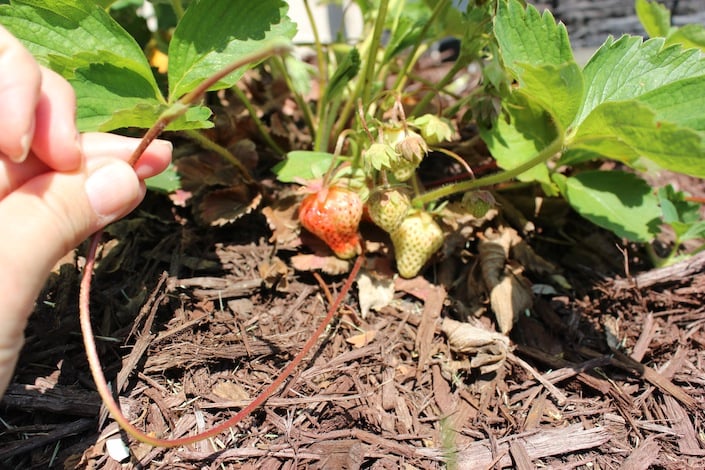
To remove the runners, follow the runner to the central plants base.

Notice that the my runners have red stems. Not all red stems are runners though so make sure it is a runner before removing. Also depending on the variety, the stem might not be red. A runner is always longer (or running) from the central plant. Now simply remove the runner at the base of the plant.

By removing the runner you are allowing the central plant to get all the nutrients it needs to produce a lot of wonderful and delicious strawberries! This simple step of removing runners will allow your garden to flourish with strawberries. Strawberries are one of the easiest fruits to grow. So why not give it a try? Once you have home grown strawberries out of your garden, it is hard to go back to store bought. They really are that good! Happy gardening everyone!
Interested In Getting More Organic Tomatoes Out Of Your Garden?
If you like this post, then be sure to check out this post:
Follow This One Tip And Get A Ton Of Organic Tomatoes
You may not be getting all the tomatoes that you could be from your tomato plants. I implemented this tip in my garden this year and had to give away my tomatoes, I had so many! 🙂

Photo Credit: » Zitona « via Compfight cc


I bought a metal tub, the kind used by my grandma as a small bathtub, I placed it on top of an old stump in the middle of my garden and filled it with strawberries. The slugs will not climb over the galvanized metal!! I have to trim back runners and keep other plants around it short so that the slugs can’t climb something else to get in. This is year three with no slugs in my strawberries, best thing ever!
can these runners be propogated into future strawberry plants?
Sure can Rachel. Just put the ends in a bit of soil and watch them grow 🙂
@rachel When buying strawberry plants from the nursery I always look for plants with runners. That way I get more bang for my buck, kind of like getting two (or three) plants for the price of one. The runners (they are the like the “babies” on spider plants) catch up to the original parent plant very quickly. I have filled in strawberry beds very quickly this way.
Hi Everyone,
Your site is very interesting, and I am learning all sorts of things. But, I think somehow I am confused or not understanding about what a runner is on a strawberry plant. In your pics above, it looks at though there are 3 runners from the main plant. How do I decide which is actually the runner and know which one to cut. Thank
3Feathers The runner actually “runs” from the main plant. You can have 3,4, 5…runners to one plant and you would remove them all. It will be a long stem that is “running” away from the central plant. Hope this helps clarify things a bit.
Last year was my first time trying Strawberries, I am so thankful to get this information on the runners. I didn’t do anything with them last year and I can now see that might have been why I had a bunch of tiny fruit. My question is now this…I am in Denver and we just had our last frost so the plants have just recently started to flourish. NONE of the original plants have returned, but ALL of the runners have! So, what do I do now? Choose a few as”base” plants and pinch back the runners to one or two? I planted 8 plants last year…I’m pretty sure there are 40 out there now. HELP?!
Yep, just remove the runners and leave a few central plants. The 8 you planted might surprise you and come back. Remove the dead leaves to allow the center of the plant to get more light. I’d be surprised if the plant didn’t come back:). Do keep us posted.
So I am setting up a little strawberry garden in a plastic kiddie pool (Have one from last year that never got used). Any tips to starting a new strawberry patch this way?
nboone1984 What a GREAT idea! Strawberries can spread quickly and this is a great way to contain them. You only need 6 inches of soil, so save yourself some money and don’t worry about filling it all the way. I usually plant 4 plants per square foot.
Make sure you drill some holes in the bottom of the pool before you fill it with soil so it can drain properly. Please do keep us posted and email me some pictures along the way. (my email address is in the ‘contact us’ tab above. 🙂
hallecottis
I thought i would give a little update. We are getting
some great berries! They are just starting with the late winter we had
in SD but in the next few weeks there are great signs of a good harvest.
(I would have loved to try some but my 4 year old is the picker and
such the eater) Here is what we did; we started with a 4ft kiddy pool
drilled a bunch of .75in holes in the bottom, layered with mulch, the a
mix of potting and garden soil about 4 inches (the mulch was a couple
inches too) then we did 6 plants. we also planted dill and cilantro
around the edges and covered the bare soil with a little mulch and
covered with coffee grounds. we have a very large bunny population in
our area and i have not seen one sign of bunny theft! So my mom giving
me the “are you kidding me look” for collecting coffee grounds at work
was totally worth hear a week later “i cant believe the bunnies have not
touched it, the coffee grounds must have worked” talking to another
coworker. I posted my starter pics and an will post updates on my page
if you want to check it out! https://www.facebook.com/nicole.boone.18
I keep hearing how easy it is to grow strawberries but all im getting is tiny misshaped berries that are no good. Can somebody help me with this issue
so i was told with srawberries to through away the parent plant and to use the runners as parent plant would not produce fruit again is this tru
FirstMinda ElkeDay I stumbled across this slug killer by accident. i had an old crystalized jar of honey. i wanted to save the jar so i put it outside in a flower bed and filled the jar with water from the hose. the old honey was only about an inch high in the jar before i filled it with water. a few days later i saw the jar again. it had about ten big slugs in it. they love the sweetness and wouldn’t leave the jar. magic.!!!
We’ve had strawberries for a few years and they usually do pretty well except last year (2012) which was really dry. They’re in a low place, and we have clay soil, so they generally get quite a bit of moisture from the snowmelt and spring rain — which didn’t happen last year and we weren’t ready for it — we didn’t realize how much we depended on that happening. It was a very sad year and I had to buy strawberries to make the yearly jam. It wasn’t nearly as good.
We do have a few problems I haven’t found solutions for yet:
1) They’re not mulched. I’m just learning to implement that in the regular garden and flowerbeds this year. It looks like you have some kind of woodchip mulch which is similar to what we’re using now. It’s so wet in the spring that we can’t get out to weed and we have dandelions and trees growing to their hearts’ content! We’re mulching with newspaper/cardboard covered with a few inches of woodchips in our other areas. Is that what you’re doing with your strawberries?
2) My hubby and his dad (who shares the strawberries and lives next door) like to keep the rows wide — 3 to 4 feet. I think that’s too wide since you can barely reach in without crushing other berries and plants. It used to be more like 6 feet, so we’re making progress. How wide are your rows?
3) We have NOT been cutting off the runners — didn’t know WHAT to do with them and thought they were free plants, like others on here. You said they’d produce for about 3 years. Would you allow some runners that third year, then, and dig out the parent plant?
Thank you for this great information!!! It feels silly to have such great berries but have no control over the bed!
Does it work to cut off the runners on Everbearing strawberries too?
Thank you for these wonderful ideas