 For many years now, I have been growing my own strawberries. The first year that I attempted to grow strawberries, I was so overwhelmed and very disappointed. I didn’t know which varieties to buy, how to grow them, why my strawberries weren’t producing a lot of strawberries, and what a “runner” was and how it dramatically could effect my harvest! Today we are going to learn about strawberries and how to get the best yield out of your strawberry plants.
So lets talk about the different varieties of strawberries and strawberry types. There are hundreds of different varieties but there are only three strawberry types. The three types of strawberries are June-bearing strawberry varieties, ever-bearing strawberry varieties and day neutral strawberry varieties. Here are descriptions of the 3 strawberry types provided by StrawberryPlants.org.
Strawberry Types & Varieties
June-bearing strawberry varieties:
Any list of strawberry varieties will probably contain more June-bearing strawberry varieties than any other. June bearers are tremendously popular and common. They typically produce the largest strawberries, and do so over a period of two to three weeks, on average. Most June bearing strawberry varieties produce a harvest around the month of June, hence the name. However, strawberry varieties are further classified into Early Season, Midseason, and Late Season. By selecting strawberry plant varieties that produce during different parts of the season, you can prolong your harvest and enjoy fresh strawberries for an extended period of time. June bearing strawberries are most often of the Garden Strawberry variety (Fragaria x ananassa). June bearing strawberry varieties are often planted using the matted row system.
Everbearing strawberry varieties:
Everbearing strawberry varieties aren’t really “everbearing.” They generally produce two harvests per year: one in the spring and another in the late summer or fall. Under ideal conditions, it is possible for some everbearing strawberry varieties to produce three berry harvests. Most everbearing strawberry types are of the species Fragaria vesca. In general, everbearing strawberry varieties put out less runners (or no runners at all) than the June bearing varieties, as most of the plants productive energy is directed toward producing multiple strawberry harvests. Everbearing strawberry varieties are often planted using the hill system or in locations where space is limited.
Day-neutral strawberry varieties:
Day neutral strawberry varieties are unique. Unlike June bearing varieties, day neutral strawberries will produce a good yield in the first year they are planted. They flower and set strawberries whenever the temperature is between 35 and 85 degrees. They will still be producing fruit in October during milder years. The drawback to day neutral strawberry plants is that they produce smaller strawberries than do the June bearing and everbearing strawberry varieties. Their fruit is usually small to medium in size, rarely exceeding one inch. Day neutral strawberry varieties are often planted using the hill system or in locations where space is limited.
Here is a great chart that will help you find the right strawberry type and variety for your region as well as the desired flavor you are looking for. Keep in mind, oftentimes strawberries are much sweeter the smaller they are. If they are larger, they often times have a lot of water in them making them not as sweet.
Strawberry type and varieties chart
Follow This One Tip In Your Garden & Get A Ton Of Organic Strawberries!

So now that you are a bit more educated about the different types and varieties of strawberries, lets talk about how to get the most out of your strawberry plants! In my garden, I have the ever-bearing strawberries and June-bearing strawberries. We eat strawberries all season long on these plants and they produce enough strawberries for our family that I have no need to even buy them at the farmers markets.
My everbearing strawberry plants are pretty much maintenance free, just plant and pick. My June-bearing take a little more work, but it is well worth it. June-bearing is one of the most planted strawberry types in todays gardens. My first year, I got very few strawberries. What was I doing wrong? I wasn’t pinching off my runners! “Runners”?? Let me explain.
When you purchase your strawberry plant, you have a central plant. As it grows it produces runners. Runners are long stems that run off the central plant and create baby strawberry plants. These baby strawberry plants suck the nutrients out of the central plant and the central plant will lose its ability to produce fruit.

This might sound great, you automatically get more strawberry plants for free, but it is not a good thing! Again, these “runners” strip the central plant of its nutrients and the central plant will produce only a very little amount of strawberries.
So if you want to have a ton of strawberries, You must remove the runners!
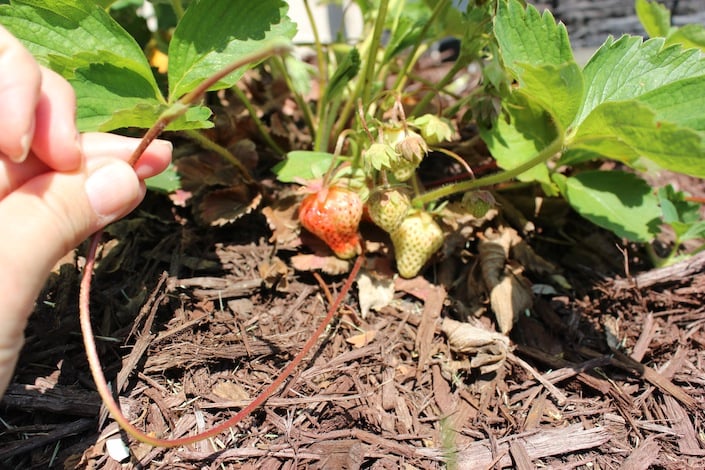
To remove the runners, follow the runner to the central plants base.

Notice that the my runners have red stems. Not all red stems are runners though so make sure it is a runner before removing. Also depending on the variety, the stem might not be red. A runner is always longer (or running) from the central plant. Now simply remove the runner at the base of the plant.

By removing the runner you are allowing the central plant to get all the nutrients it needs to produce a lot of wonderful and delicious strawberries! This simple step of removing runners will allow your garden to flourish with strawberries. Strawberries are one of the easiest fruits to grow. So why not give it a try? Once you have home grown strawberries out of your garden, it is hard to go back to store bought. They really are that good! Happy gardening everyone!
Interested In Getting More Organic Tomatoes Out Of Your Garden?
If you like this post, then be sure to check out this post:
Follow This One Tip And Get A Ton Of Organic Tomatoes
You may not be getting all the tomatoes that you could be from your tomato plants. I implemented this tip in my garden this year and had to give away my tomatoes, I had so many! 🙂

Photo Credit: » Zitona « via Compfight cc


I will follow these instructions for my garden.
I just want to say that your advice is very sound and logical. Most of your information also depends on location and weather. In our area of Wyoming, we have grown strawberries for over 15 years. I think you should really stress that runners are needed to repopulate a garden. Without these runners you will get no strawberries, no matter the type of producing plant. After 3-4 years your mother plants will cease to produce. The new runners/plants are very important for the future of production. We have found, as you state nutrients are a driving factor. We use a specialized formula for strawberries, and apply it twice per year. No berry production could also be due to the pest factor, such as birds, snails and many other varieties of pests. Remember to protect your plants, either using toxic or non-toxic methods.
Thanks for the tip. We planted strawberries in a raised bed 2 years ago. The first year we got a lot of beautiful berry. Last year not one! They are quite thick – probably because we didn’t remove the runners. They are everbearing and we live in TN. and have clay soil. We heard that it was too wet last year and everyone’s crop was way down. My question since we let those runners establish themselves, are the main plants now useless? Do we need to replant? Thank you!
I really love your site.. Great colors & theme. Did you create this web site yourself?
Please reply back as I’m trying to create my own personal blog and
want to know where you got this from or just what the theme is named.
Thanks!
If we do strawberries in a planter jar will we need to worry about runners as much? and what varieties do best in the planter?
Last year which was also the first year the strawberries were there, the birds managed to eat all the blooms. This year I have flowers but no berries. What am I doing wrong? Why can I not get berries to produce? Please help
This year seems to be a late year for many strawberry growers. The blooms should turn into fruit soon.
I very new to growing strawberries im from California i bought 10 All star plants from home depot but their steams are red but are getting bigger and still have nice big green leafs is it something i need to worry about please help?
Karen I am confused on what your issue is? Can you explain a bit more so I can help?
HI, I was in our local greenhouse the other day to ask the “greenthumbs” there about why my strawberry plants have been only producing little “nubs” of berries for 3 years now. The nubs are just really, really tiny berries that look like they haven’t developed all the way and arent worth picking, they’re that tiny. Anyway, the lady bluntly told me that if I didn’t spray the early blooms with malathion, the little nubs are all I could ever expect to get out of my strawberry plants. I find this extremely difficult to believe that organic strawberries are not possible. Can anyone here tell me otherwise??? I really don’t want to have to start spraying my plants again!
I have a question. every time my strawberries began to grow and turn a lil red. ants come along and eat them before they finish growing. I read some where to put mulch around them. I have absolute red organic ground cover can that be placed around the strawberries? ( I didn’t put them under and close to the plant just around the grounds)
Thanks for the tip to get good strawberries that one should remove the runner. I am going to do it today itself. I planted organic plant but it is giving small strawberries. This should solve the problem. Thanks again. 🙂
Couple of tips I want to share that worked for me to protect strawberries from squirrels and other animals. I put a plastic fence around my strawberry bed (you get 4 ft X 8 ft fence in home depot for ~$7), a plastic owl and bird net (this does not harm the birds if you cover the bed with one layer, you get this also in Home depot).
I like the helpful information you provide in your
articles. I will bookmark your blog and check again here regularly.
I’m quite sure I will learn many new stuff right here! Good luck for the next!
Several people have questioned why their berries are small and mishappen but noone has replied yet. I have second year strawberries that I transplanted from rain gutter containers this year which is their second year of growth. Most flowers were removed last year. They are now in large plastic pots and have grown really well and look healthy. Lots of sun and watered well. They actually have many many flowers, but they are small and only rarely grow into real strawberries. I keep removing these when it is obvious they are not going to mature. It almost seems like there are too many flowers. This has happened all summer and they are still flowering now October 11 2014, but so few mature strawberries have been produced. I have 10 large containers with two plants in each. Not many runners. I’m wondering if we have enough bees. Would mason bees help? I have tried fertilizing with a feather and perhaps those are the berries that have ripened. Very disappointing, probably only about 3 dozen berries grew large enough to eat. I live on the s.w. coast of Vancouver Island.