
Sourdough bread is a great alternative when wanting a healthier bread. If you haven’t read my article on sourdough bread, you can read it here: A Healthy Bread That Is Good For You! I have always loved an authentic sourdough loaf. A true sourdough loaf is made with wild yeast or a sourdough starter. If you haven’t read my post on how to start a sourdough starter, you can do that here: How To Start Your Own Sourdough Starter. This loaf of bread has 4 ingredients, that is it! It is super easy to make but does take some time to ferment. This dough actually ferments for 19 hours. Don’t let that scare you…the whole process will take you 10 minutes of prep time and the rest of the time the dough just sits there getting better and tastier.
There are several things that you will need to get started. It is a good idea to have a digital scale to measure your ingredients but is not absolutely necessary. I do my best to show you how to utilize what you have in your kitchen so you don’t have to buy any special equipment. I use a dutch oven to cook my bread in. Often times people will cook sourdough in a La Cloche, but I find it just as easy to use a dutch oven. Another item that is often used when cooking sourdough bread is a proofing basket or a round brotform (pictured at bottom of post). Again, I just use what I have in my kitchen. You can make a proofing basket by using a colander lined with a thin towel (not a thick towel). You might want to purchase a Danish dough whisk, but a slotted spoon works as well. See the bottom of this post to see where you can purchase these items. I have pictures showing you all of this. This recipe was modified from Breadtopia, a great website that teaches us all how to make a better loaf of sourdough! So let’s get started.
The first thing you need to do is measure out 350 grams (1 1/2 cup) of filtered water (at room temperature). Place water into a ceramic bowl, not metal. Stir in 3 tablespoons of honey. If using raw honey, melt the honey on low heat until it turns into a liquid.

Add 1/4 cup of sourdough starter (learn how to make your own sourdough starter here) to the water mixture and mix well. Your sourdough starter should look like this.


Add 1/4 cup of this starter to the water mixture and stir well.


In another bowl, measure out 530 grams (about 5 cups fluffed) of 100% whole spelt flour. Add 10 grams (1 1/2 tsp) of unrefined sea salt and stir. Please note, you need to use whole spelt flour, other flours will not work with this recipe.


Mix the flour mixture in with the water mixture. Stir with a slotted spoon until well combined. The dough will be a wet dough.


Cover with plastic and store in a warm place for 1 hour.

After 1 hour, dust your hands and the top of the dough with flour. Pick up the dough and stretch and then fold the dough. Stretch once again in the opposite direction. Place back into the bowl and cover with plastic for another 1/2 hour. After a half hour, do a second stretch and fold in both directions. Put back in the bowl and cover with plastic for another half hour. After a half hour do a final (third) stretch and fold in both directions. Place the dough back into the bowl and cover with plastic and allow it to sit overnight. I usually start this whole process at 3:30 pm and bake it the next morning at 9:30 am.


In the morning you will need a wood cutting board, a colander and light dish towel.

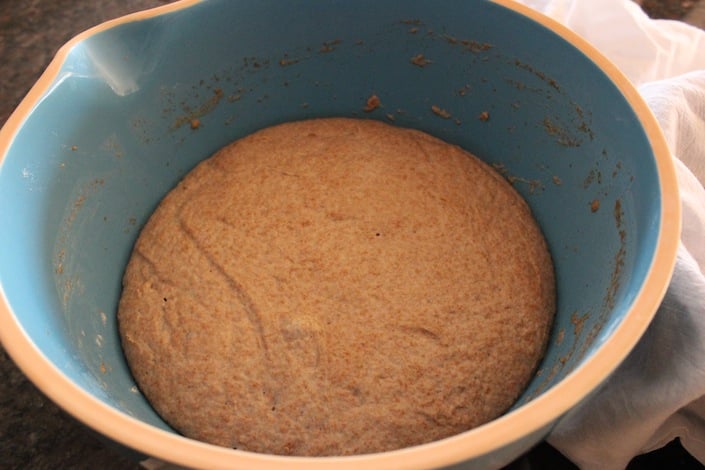
This is what your dough will look like in the morning. Yours might rise a bit more, it all depends on the weather and how warm your kitchen is. It was cooler in my kitchen, so it didn’t rise as much, but don’t let that alarm you, it will still rise as it proofs and cooks.
Flour the cutting board, hands, the dish towel in the colander and the top of the dough with rice flour. Gently scrape the dough out of the bowl and place it onto the cutting board. Pull the sides up and pinch the dough at the top. Place dough into the lined colander and cover with plastic and allow the dough to rise for another hour and a half.


In a 400º-450º F oven(temperature might vary depending on your oven, 450ºF was too hot for me, I cooked mine in a 400º F oven). Preheat a dutch oven with a lid on for the last half hour that the dough is rising. Pull the very hot dutch oven out of the oven and gently transfer the dough into the hot dutch oven by flipping the dough gently out of the colander. Put the lid back on and return to oven and bake for 35 minutes. After 35 minutes remove the lid and allow to bake for 10 additional minutes or until the internal temperature reaches 195º-200º F.


Remove bread from Dutch oven and allow the bread to cool for 1 hour before serving. Serve with some grass fed butter and enjoy!

How To Make A “Real” Sourdough Spelt Loaf
 Prep Time: 20 minutes
- Cook Time: 45 minutes
- Total Time: 1 hour 5 minutes
 Yield: 20 pieces 1x
 Category: side dish
 Method: baking
 Cuisine: american
 Print Recipe
 Pin Recipe
Description
Learn how to make your own sourdough spelt loaf. It really is quite easy!
Ingredients
- 530 grams (5 fluffed cups) spelt flour
- 3 tbsp honey
- 350 grams (1 1/2 cup) water
- 10 grams (1 1/2 tsp) unrefined sea salt
- 1/4 cup sourdough starter, see recipe
Instructions
- See Instructions in this post
Notes
Nutrition Info: Calories: 143.8 Fat: 1.0g Carbohydrates: 28.5g Protein: 4.1g
Nutrition
- Serving Size: 1 piece


I’ve made this recipe twice and can’t seem to get my dough to rise during the final proof and bake. Taste good but flat. Have you tried this with a refrigerator proof?
★★★★
will this recipe multiply by doubling tripling etc. all the ingredients? If so, is the starter multiplied accordingly or is there a different equation?
I have made this recipe 3 times now and each time the loaf is very dense and heavy. Do you know what I can do to make it lighter and airier? Thank you
If it is dense, it is most likely a combination of the flour and/or the starter. If you are looking for a lighter loaf, you might want to try this version of my sourdough. https://wholelifestylenutrition.com/recipes/traditional-san-francisco-sourdough-bread-recipe/
How much bigger should the bread be from 3:30pm to the morning? Double in size? Tripled? Something else? Thanks!
It depends on many factors. Good rule of thumb though is double in size.
Hello
Just read a lot of this very interesting thread , and found it really interesting. I have a few suggestions that might help, especially beginners (who should bear in mind all sourdough freaks have made loads of mistakes along the way, and often taken years to get the bread from OK – to fantastic).
1. Start with strong white bread flour for the starter and loaf if you’re a sour-dough virgin. It won’t be as subtle in flavour – but easier to work with. As you make loaves more often, graduate to feeding your starter with rye, wholemeal, spelt – whatever. Each will offer a different flavour to your bread, and you’ll develop a preference. In time you can increase the amount of such flour to your main dough. By this time you’ll have a feel for what the dough should look like when rising, after baking etc.
2. Cheat when kneading. Graduate from a less wet dough, to a stickier dough (as water content makes a big difference to taste and texture). A little cooking oil on the kneading surface helps prevent too much sticking to your kneading hand. Try to knead with one hand, then use a knife (not too sharp) to scrape off dough from your kneading hand. Obviously your hands should be scrupulously clean before starting. (Sorry to be gross – but if the back of your fingers are hairy, don’t scrape hairs into your dough). Reduce the oil as you get more adept at kneading.
3. Kneading: little and often in the first hour. Try kneading at 10 minute intervals (for around 30 seconds) for the first half hour, and another knead after another half hour. OR…..knead once and pop it back in a bowl – or your tins if using tins. There are plenty of people who barely knead at all – and if your dough is going to rise very slowly, this is fine, especially if you are new to baking sourdough. As you gain experience, you can experiment with kneading, and check out the different results. (My personal preference is: initial knead, after 10 mins, 10 mins, 10 mins, 30 mins, 2-hours and then into bannetons for final rise).
4. Tins (see bannetons further down): Not as good as bannetons (proving baskets) and a dutch oven – but so what? Try both. Tins are great for controlling the rise and the bake…but they should be well-seasoned tins, so if new, oil them well before putting the dough in. In time – they won’t require any oil. Cover with some oiled cling-film (this stops the dough sticking to the cling-film) and leave to rise.
5. Rising time. I used to have little idea when I would be able to bake. The fridge is your friend. If the rise is too fast for your timetable, stick the tins in the fridge. I’ve baked after 6 hours on a hot day, and after 36 hours on hot days….by putting the tins immediately in the fridge, then taking out a few hours before baking. Bread almost ready to bake before bedtime? Stick it in the fridge….but don’t have a lie-in!
6. Baking with a tin. Everything said about dutch-oven is important. You want to create the equivalent of a baker’s oven which uses steam-especially in the first part of the bake. A dutch-oven creates the same conditions by trapping steam coming from the bread. If you have a baking tin the same size as your bread tin, try inverting it on top of your baking tin. Bake like this for 20 minutes or so, then remove. (Play around with timings-as you want a well-cooked loaf with a dark crust – but not a burnt crust, so replacing the upturned tin in thre latter stages of baking can also help avoid burning the crust. If you haven’t another tin, try covering with foil (tricky if your oven is fan assisted though). Or try a cloche – see further down).
7. Try also adjusting the temperature of your oven. Generally -as hot as you can get it for the first 15-20 minutes, then reduce the temperature for the rest of the bake. This is trial and error – no-one can advise you as it will depend on so many variables (wetness of your dough, time it took to rise, type of oven, time in oven……).
8. Bannetons: You’ll need (no pun intended) a good sense of humour if you’re going to get going with these….but it’s worth it. If using for the first time, spray with water Using a fine spray gun which ha only been used for water), then put in some flour – a tablespoon or so (or I think what Americans call a quarter of a cup), and slide it around until the banneton is covered all round. Leave to dry.
When you do your final knead before placing in the banneton, sprinkle more flour in the banneton and on the dough before placing in the banneton. Sprinkle some more on top of the dough, and cover with a tea-towel/clean cloth, whatever.
9. Turning out the dough: More fun. If your banneton and dough were well floured you should be OK – but basically, flip the banneton over onto your tray, and it should release from the banneton and be ready to pop into your hot oven. NB – the banneton doesn’t go in the oven.
HOWEVER – if you’re new to this, the dough may stick – and this is a real pain, because you want to disturb the dough as little as possible. Try leaving it alone for a few minutes, as the banneton will help hold the shape, whilst the dough gradually un-sticks itself. You can try gently easing it away – but just accept this loaf won’t be perfect, and try not to cry too much. Chances are – it will still be good.
Why does it stick?: The banneton and dough weren’t floured enough. The dough was too long in the banneton. God, in his infinite wisdom decided to pick you out for punishment…..have you been indiscreet?
10. Dutch oven/cloche: As pointed out earlier – you want to steam the bread. A dutch oven can be created with a pan with a lid. I avoid anything with aluminium. A cast-iron pot is good. You can try just putting it in a cold pot then transferring to your hot oven. This is fine, and you won’t get serous burn from trying to get the dough from banneton to pot. Most advice suggests getting the pot really hot – so as you gain experience at tipping out from a banneton – you can move on to a hot pot. A clay cloche must be heated through – put into a cold oven and heated up until the oven is up to temperature, before transferring the dough. An easier method is to turn out the dough onto a tin, and use an upturned pot (Like a stock pot) over the dough. The pot will need to be larger than the circumference of your banneton, and with space for the dough to rise (which it will do more than you’ve been used to if you haven’t steamed your bread before). Remove the pot after 15 minutes or so – then use it off/over the bread to control the colour of your crust (ie to avoid burning).
Wow, thanks for all of these tips David!
Great advice. I think the most common problem in the previous comments is “gloopy dough” and I think that’s caused by over-proving. Would you say that tip number 5 applies? i.e. leave the dough overnight in the fridge and it will slow down the process so that the dough still has some integrity in the morning when you bake. I put it straight from the fridge into the oven and it works really well.
★★★★★
Such wonderful tips thanks David!
★★★★★
Have you ever tried it without the salt or honey? We don’t eat sweeteners or salt, but I’m wondering if either of those contributes to the leavening process. I have made spelt sourdough before (using different directions), and it didn’t rise, so maybe that’s why?
I answered my own question. Tried the recipe as written and again without salt or sweetener. The loaf rose and came out with a delightfully sour taste! Definitely no salt or honey needed!
Thanks for sharing your results, Rebecca! Happy to hear it worked for you!
I’m so excited to be making this bread. This recipe and all the comments inspired me. I had been buying spelt bread at a local market but when they stopped baking it I decided I need to do it myself. I have just an hour and a half to go before I bake it. My question is colon do I need to grease the Dutch oven or bread pan? Thank you so much!
Hi Denise! No, you do not want to grease the bread pan or dutch oven. Good luck and let us know what you think!
Do i not need to score the loaf before baking?
I really enjoyed making this recipe. The only challenge I had was flipping the dough into my dutch oven, however it did right it self somewhat and I still had a pretty nice loaf and it tasted amazing.
One Question. Could I add some flax to the loaf? I read a few other recipes that suggested soaking the flax in water first, however I don’t want to throw off the recipe.
★★★★★
Gald you enjoyed the bread, Chriss. I have not tried using flax and don’t foresee any issues with using it, but with baking, you never know until you try. If you do decide to try it, let us know how it turns out.
I’ve literally never baked bread before let alone sourdough bread. I grew my own start with the help of your other post and successfully baked a delicious loaf of sourdough with literally nothing going wrong because of this post. Thank you for this info! I couldn’t have done it without you. Not sure if elevation would affect bread generally, but I live in Denver so I was a bit worried how it would affect things and it doesn’t seem to have been an issue!
So happy that you are enjoying your bread and thanks for sharing your information about elevation. I’m sure it will help others who are trying this recipe for the first time.
Hi Halle, in your recipe you use 1/4 cup sourdough starter. How much grams it? Thanks
So delicious! Turned out great!
★★★★★
Can I use parchment paper in place of the dish towel and then place dough and parchment in the heated pan?
Hey Colleen, the dough might get a little dry with just parchment paper. I don’t see why you couldn’t use a combination of both though…