
I am so lucky to have such a wonderful neighbor who explores as much as I do when it comes to food and gardening. Yesterday Tracy invited me to learn how to make homemade organic raw mozzarella. We were both very surprised at how easy it really was! The hardest part was locating some raw milk (and I live in a dairy land, so that really wasn’t all that hard!). I am going to walk you through the steps one by one. There are a few things to note.
- You can easily purchase a kit that will give you everything you need (with exception of the milk) to make mozzarella and ricotta cheese. You will be able to make these cheeses 30 times with this one kit.
- You will need some raw milk or non-homogenized whole milk.
If you are not purchasing the kit, you will need to purchase the following:
- You will need to purchase some calcium chloride if using non-homogenized whole milk (you do not need calcium chloride if using raw milk). You can buy it online or here is a guide showing you where you can purchase this. It really is easy to find.
- You will need citric acid powder and can purchase it here
- You also need liquid rennet and can purchase that here
- Pickling salt or kosher salt is needed.
This recipe came from 200 Easy Homemade Cheese Recipes by Debra Amrein-Boyes
1. Sterilize all equipment. In a small glass bowl or measuring cup, dissolve citric acid powder in 1/4 cup lukewarm water, stirring with a stainless-steel spoon.

2. In a large stainless steel pot, combine milk and dissolved citric acid, stirring to blend well with an up and down motion.
3. Place the pot over medium heat and warm milk mixture to 88ºF, stirring gently to prevent scorching. Remove from heat.
4. Dilute calcium chloride in 1/4 cup cool water. Do this step only if you are using non-homogenized whole milk. Add to milk using the same up and down motion. If you are using raw milk, this step can be eliminated.
5. Dilute rennet in 1/4 cup cool water. Add to milk and using the same up and down motion, draw rennet down into milk until well blended. Cover and let sit for 30 minutes. Check for a clean break (as shown in the picture below). If the curd is still too fragile, cover and let sit for another 15 minutes or until a clean break is achieved.

6. Using a long-bladed knife and skimmer, cut curd into 1/2 inch cubes. Let stand for 5 minutes to firm up the curds.

7. Place pot over low heat and slowly warm curds to 106ºF, stirring gently and continuously, adjusting the heat as necessary to make sure it takes 20 minutes to do so. Turn off heat and continue to stir for 20 more minutes. Let stand for 5 minutes.
8. Meanwhile, in another pot, bring 4 quarts fresh filtered water to a boil. Add 6 tbsp pickling salt and stir until dissolved. Turn off the heat.
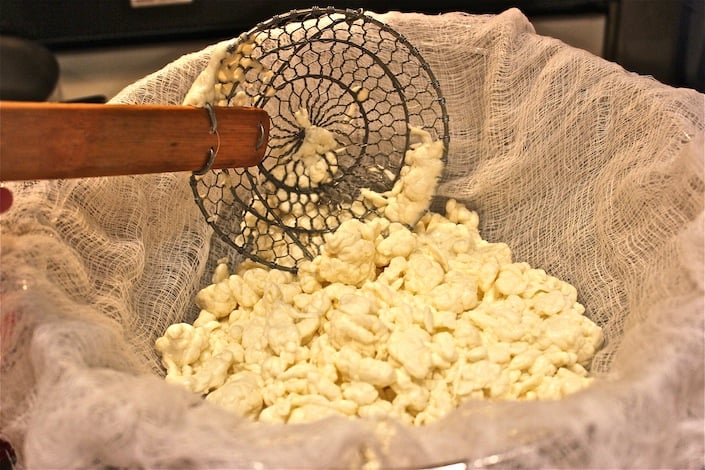
9. Drain off whey through a colander lined with cheese cloth. Let drain for 15 minutes.
10. Place curd mass on a clean cutting board and cut into 1-inch strips. Place in a large bowl. Pour salt water over strips.

11. Wearing heat resistant rubber gloves or using a long handled wooden spoon, work strips under the hot water (the cheese will become very soft), pushing and pulling and stretching them. The curd will begin to stretch. Pull cheese out into a long rope, folding it back on itself and stretching again until it is smooth and shiny. Use your hands to shape the cheese into the single ball or pinch off pieces for small bocconcini size cheeses.

Tip: One of the most important steps in making stretched curd cheeses is determining the right moment to do the stretching. The acidity of the curd must be just right. To test whether your pasta filata cheese is ready for stretching, pinch off a small piece of curd and immerse it in a bowl of 175ºF water. Work the ball of cheese with your fingertips to soften, then try to stretch it into a long strand. If it breaks or will not stretch, it is not yet ready. Wait for a while longer before trying again.

12. When the cheese turns smooth and shiny place the cheese in a bowl of ice water for 5 minutes. Remove and drain on paper towel. Use immediately or wrap and refrigerate.
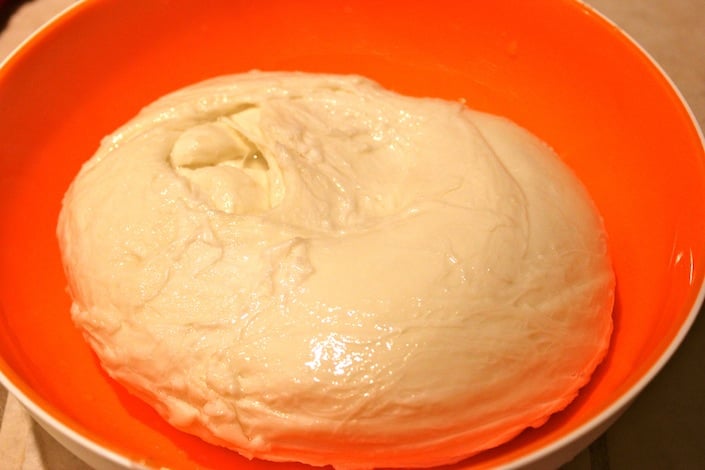 Top Picture courtesy of Cheesemaking.com.

How To Make Organic Raw Mozzarella Cheese
 Prep Time: 20 minutes
- Cook Time: 2 hours
- Total Time: 2 hours 20 minutes
 Category: side dish
 Method: stovetop
 Cuisine: italian
 Print Recipe
 Pin Recipe
Description
A How To Guide on Making Organic Raw Mozzarella Cheese
Ingredients
- 1 1/2 tsp citric acid powder
- 6 quarts non-homogenized whole milk or raw milk
- 1/4 tsp calcium chloride (this is not needed if using raw milk)
- 1/4 tsp liquid rennet
- 6 tbsp pickling (canning) or kosher salt
- Bowl of ice water
Instructions
- View Instructions above in post.
Notes
Review post above to find resources on where to purchase these ingredients or you can purchase them here.


I would *love* to do this but getting the raw milk has been a challenge….
I have been able to get raw milk by contacting my local dairy farm. I had to drive a little ways (around 30 miles) but i got my source rather quickly.
Check out realmilk.com for a farm near you.
Wow Hallle, looks great!
Claudia you can use non-homogenized whole milk which you can most likely get at a health food store or whole foods.
I have been wanting to try this…probably be awhile. School is taking up most of my free time. : (
How much does this recipe yield? We have an organic farm down the road and so I will get my milk from them. We would like to swap milk for cheese but I really need to know how much cheese I will get from 6 quarts of milk.
Thank you
Organic Mom I didn’t actually weigh it but it was a good amount. The picture at the bottom shows about how much is there, if I had to guess I would say about 12-16 oz.
My friend and I are planning to attempt this next week. I have an excellent source of raw milk!! How long does the process take start to finish (approximately)? I’m guessing 2 hours??
pennyo sounds about right. You will love it and it really is quite easy to make!
hallecottis Excellent! Seems like “simple but a lot of steps.” We’re really excited to give it a try. Thanks so much for the recipe, pictures, instructions and quick answers!!
your not organic if you use the ingrediants shown
Hello, thanks for this great detailed recipe.
Is the milk meant to start curdling as soon as you put the rennet in? I am using rennet tablets, citric acid and raw milk and find I need to add vinegar to get it to curdle.
Thanks
How does it stay raw if you put the boiling salt water on it? Is there another way?
You are not pouring boiling water over your cheese. 🙂 Step 8 of the recipe says to turn off the heat under the water after the salt dissolves. Since Step 9 takes 15 minutes, by the time you get to the end of Step 10 and pour it over the cheese, the salt water will have cooled significantly, however to what temp it will have fallen I couldn’t guess.
I have 4 gallons of raw milk that have been in the refrigerator for several weeks – I would consider them soured at this point…..and I know there are many ways to use soured raw milk…..and I am hopeing this rececipe is one if them. Do you think I can use soured raw milk that has been kept in the fridge to make this cheese?
THANK YOU
~toni
My guess is yes. Since you didn’t use a specific bacterial culture it might taste a little different, but it will definitely still make cheese.
Just thought that I’d mention that this was the only mozzarella recipe that I’ve seen asking for calcium chloride in the recipe. When I looked online to add it to my order, it said NOT to use it in mozzarella as it will inhibit the stretching of the cheese. So might be worth double checking before using. 😉
★★★
I am in the process of doing this right now with a 1/2 gallon of soured raw milk that I’m trying to salvage, using similar instructions from a cheese-making book. (Actually it involves draining the curds, nuking them and then kneading the extra whey out a few times; but I haven’t gotten that far.) I’ve presumably finished the first part of the process, having heated the milk (using a thermometer) and stirred in the citric acid and rennet, but no break has occurred. I have a slightly grainy liquid with no distinct curd or whey. I’ve done this many times with pasteurized milk with fine results, and I would think this would be even easier with raw. What is wrong?
Terry, (by now you’ve probably figured this out, but for other readers, here’s my two cents): I’ve had that problem w my raw millk mozzarella once and here’s what I think is happening: “old” soured raw milk has a higher bacteria count, therefore the temp mentioned in the recipe works fine with fresh raw milk, but doesn’t kill enough bacteria off with an older milk (like mine that was 2-week old milk, but wasn’t curdled yet). By increasing the temp slowly, I think I went to about 100degrees or a bit higher, I killed more bacteria and I successfully used the recipe after that. Many recipes I’ve read state to use fresh milk, so I reasoned that was my issue with non-curdling.